
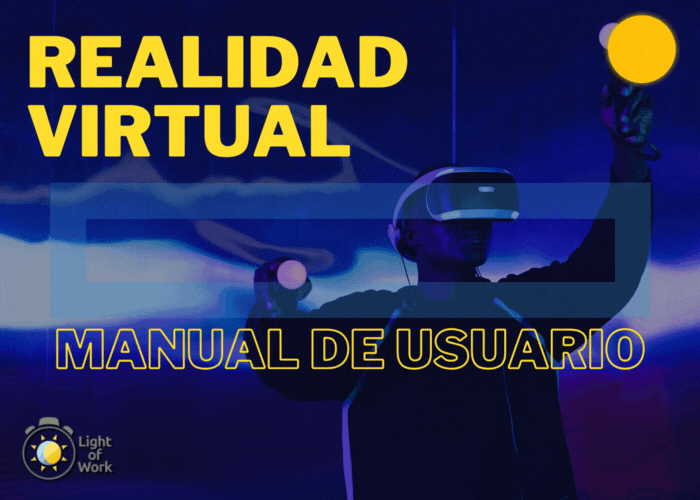
Today's technology is catapulting us into an ever more virtual reality: between the digitalization of devices – thanks to the use of industrial cloud platforms – and ultramodern Virtual Reality (VR) devices, the new millennium is becoming more challenging for businesses every day.
In fact, one of the technological novelties of 2024 is the headset released last February: a device that, simply by putting it on over your nose, takes human beings into an experience between reality and the virtual world, as if they were inside a Steven Spielberg science-fiction movie.
What is Virtual Reality?
Virtual Reality is a digital tool that makes it possible to view an alternative virtual world. This technology has two facets: Virtual Reality and Augmented Reality.
- Virtual Reality: VR is a simulated reality, a digital world in which, mainly thanks to audiovisual technology, a person can be immersed in a reality that completely surrounds them, fully masking their awareness (at least visually) of the physical world around them. It is a parallel digital world in which the user is unaware of what happens in reality, seeing only the new digital environment. In other words, the surrounding world is completely cancelled out, leaving room only for virtual scenarios. Video games are a perfect example of how VR works because they generate alternative little worlds on screens.
- Augmented Reality (AR): it transforms our perception of reality by adding virtual elements to real images. A practical example is the use of mobile apps that let us see the constellations on our screens just by pointing the phone at the sky. Specifically, what such apps do is reveal something that does exist but is not visible to the human eye: the image on the screen is a real photo of the sky, with virtual elements added. Another example is the game Pokemon GO, in which the phone's camera was used to hunt for the Pokemon creatures hidden in the streets.

Image by 4to_mono on twitter.com
Worth mentioning too is Mixed Reality, a combination of VR and AR: an example is the wearable headsets we will look at later on.
How does Virtual Reality work?
There are various devices that use Virtual Reality, yet they can still be split into two well-defined categories: devices that must be connected to another machine and standalone devices. For example, some technological implementations use a computer to process the virtual environment to be recreated, while others, like the VR headset we have already mentioned, do not need to be connected to any hardware other than for displaying the results.
As for the "wireless" world, the so-called wearable (or standalone) headsets were originally divided into two categories: those with built-in hardware and those for smartphones. However, the concept of virtual reality with wearable devices now effectively boils down to devices with dedicated built-in hardware. Nowadays, these wearable solutions give us maximum performance and realism: what the user sees through the headset is a real-time representation of the virtual world.
In any case, at least one controller is generally always needed to interact or move around the digital world.
Latest updates: wearable headsets
The device most accessible to the public is the virtual headset, whose latest release is Apple's Vision Pro from Apple, a "revolutionary product that will change the role of technology in our lives", according to Tim Cook, the company's CEO.
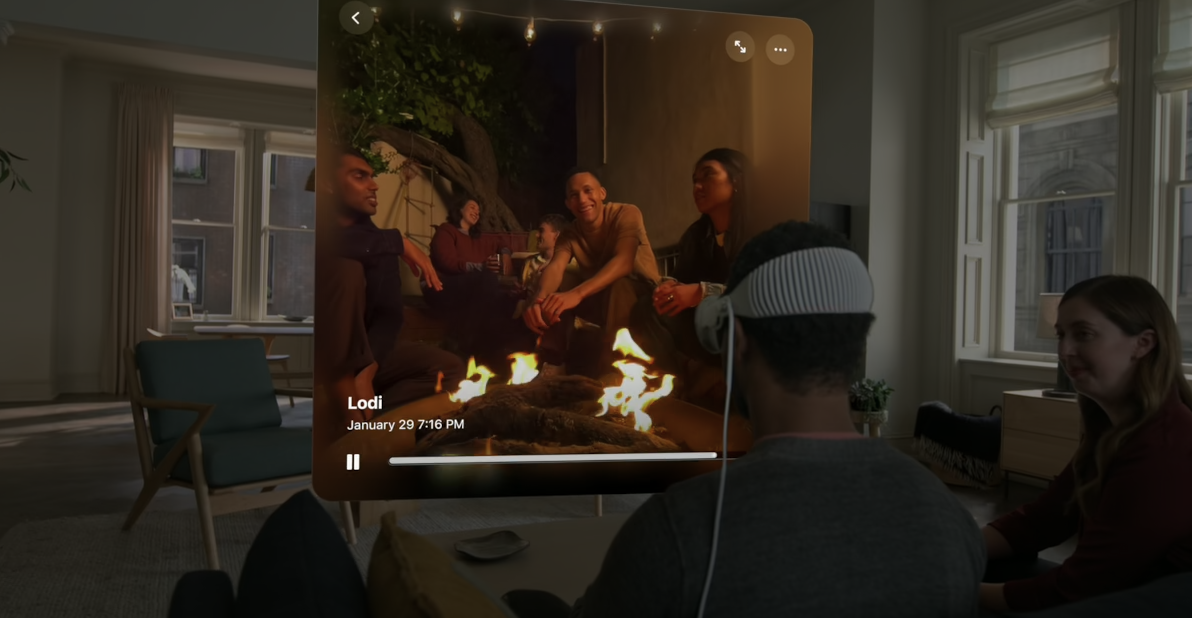
Image from apple.com/apple-vision-pro/guided-tour/
Specifically, these are sleek, high-tech glasses with 12 cameras, 6 microphones and an array of sensors, combining VR and AR. As we already know, AR joins a physical space with a virtual one, basically adding virtual elements to the wearer's real environment.
In general, the glasses can be used to view photos and videos in a "new and magical" way, and to make FaceTime video calls in which three-dimensional versions of each participant float in space. In fact, the device has a glass front that lets you see the outside world perfectly, and speaker pods in the strap, right next to the ears, so you can hear the audio.
It also has 23 million pixels across its inner displays and micro-OLED technology, plus cameras that capture panoramic images, including spatial audio.
What can Virtual Reality be used for?
Virtual Reality can serve many purposes that go beyond the typical creation of images and sound for entertainment. When we talk about VR, we are talking about an experience that fully engages all five senses. In theory, that would be the goal but, in practice, we are dealing with cases in which only two senses are involved, usually sight and hearing.
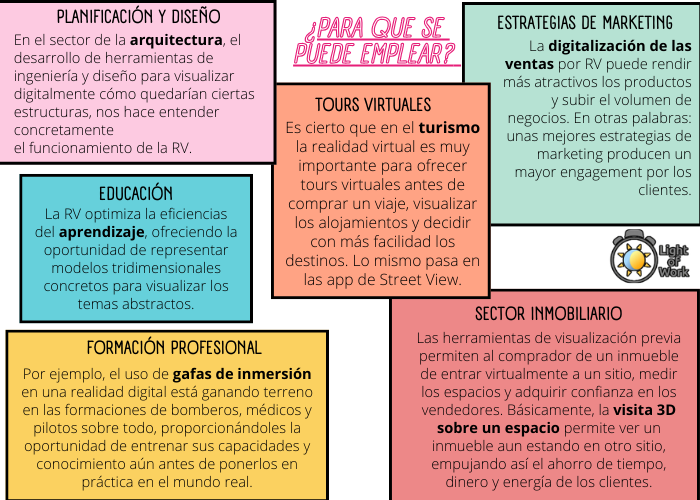
The sectors affected by Virtual Reality are varied, from education to healthcare, tourism and industry. At the business level, VR is becoming a fundamental tool for industrial development. Today, those who seem set to benefit most from VR are industries manufacturing and construction, educational institutions and the tourism and real estate sectors, as well as the fields of health and safety.
Below, we highlight a few concrete examples to show how Virtual Reality can be used.
Advantages of using Virtual Reality
- At the logistics level, it can bring greater automation to companies. Indeed, being able to carry out tasks in the same place, even in sectors that would otherwise require travel, saves money and time. In fact, potential risks can be detected in advance during the production of goods and services, in addition to the possibility of taking tasks off employees' hands.
- Increased protection thanks to advanced cybersecurity technology.
- A narrower digital divide in companies, with a boost to remote training.
- VR tools do not wear out and are more durable, can be easily multiplied, and need no storage space.
However, one rather important drawback is worth noting: a truly immersive experience requires very advanced skills, which come at a high cost and are not widely available.
Conclusions
As the analysis so far shows, virtual reality is a technology with infinite potential, on which a great deal of attention is being focused. It is an extremely powerful tool today, one that could be used in any sector and would also drive business progress without precedent.
To sum up quickly, this new immersive technology projects the user into any 3D place through a special device, hiding the real world and letting them live first-person adventures and experiences, breaking geographical barriers and simulating any scenario.
In terms of development, augmented reality has yet to have its tipping point, but better displays will surely make VR increasingly interesting, with affordable prices, pleasant to use and reaching a wider range of users.
Many efforts are expected in this direction, to allow everyone to enjoy immersive virtual reality experiences, perhaps from smartphone apps.