
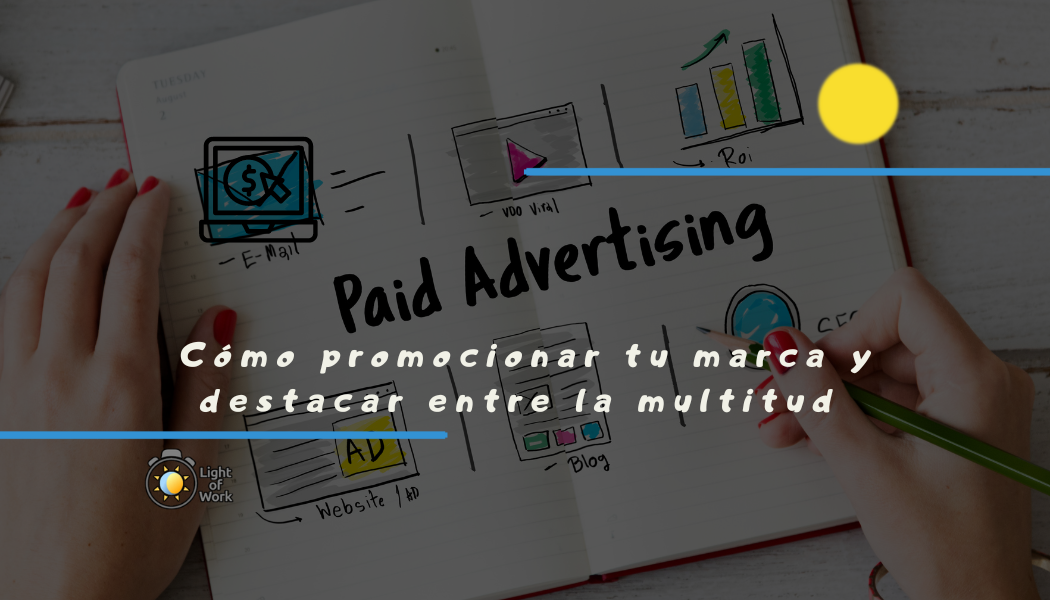
When we talk about paid advertising, or Paid Advertising, we are talking about an essential tool in digital marketing.
This strategy allows companies to promote their products, services or content by placing ads on various digital platforms and search engines, paying a fee for every click or view they receive.
The key points
Before going deeper into the topic, we have chosen three key points to better understand the concept.
- Paid advertising is an effective form of promotion that does not necessarily require exorbitant financial contributions. Anyone who uses Paid Advertising has full control over the budget allocated to campaigns (apart from the minimum thresholds imposed by some platforms) and can decide when to switch them on or off according to their needs.
- Campaign costs depend on multiple factors, such as the target audience, the advertising channel used, the campaign goal and the type of ads.
- Companies can secure a respectable position on the web, in search results or in users' feeds as they browse the different social networks.
How does a Paid campaign work?
As we already know, Paid Advertising is a type of marketing based on promoting products by paying a fee. But it is important to point out that not all advertising campaigns are paid for in the same way. So what are the main payment models?
Payment models
The payment model can vary depending on the campaign goals.
1️⃣ For example, if the goal is to increase brand awareness, a CPM (cost per thousand) campaign may be preferable, where you pay for every 1,000 impressions, that is, views of the ad.
2️⃣ However, the most popular payment model is generally pay per click (CPC), which lets the company pay only when a user clicks on the ad, but it is not the only solution available.
3️⃣ There is also the cost per acquisition (CPA), which measures the total cost a company spends to acquire a new customer through a specific campaign or advertising channel. In other words, it indicates how much it costs, on average, to convince a potential customer to take a desired action, such as making a purchase, signing up for a service, downloading an app or completing a form.
4️⃣ Finally, we look at the Cost per conversion (CPCo): this metric indicates the average cost of obtaining one conversion. A conversion cost that is too high compared with the customer's value may indicate that the campaign is not delivering the desired results.
Another can be added too ✋🏼: the Cost per view (CPV). This indicates the maximum cost of each view of a video ad of at least 30 seconds (if it is shorter than 30 seconds, the full length of the video is counted).
Metrics for analyzing performance
The three main parameters for measuring the performance of a paid campaign are the following:
- Quality Score: the quality score is the measure paid advertising platforms use to indicate the relevance of keywords, audience selection and ad quality. A high Quality Score contributes to a better ad position and a lower cost per click.
- CTR (Click-through rate or, in other words, the rate of clicks): the percentage of users who click on an ad compared with the number of times it is shown is a metric that helps evaluate the effectiveness of paid ads. A low CTR suggests the need to improve keywords or creatives
- Conversion rate: the conversion rate indicates how many people, after clicking on the ad, complete the desired action, such as a purchase or a request for information. A high conversion rate is a sign of an effective campaign.
Benefits of Paid Advertising
Paid advertising is, first and foremost, an excellent strategy for boosting content, which not only increases revenue but also drives valuable traffic to the company's own channels. By investing in content promotion, you ensure that ads remain visible on digital platforms, which results in greater exposure and brand recognition.
In addition, when it comes to search engine positioning, a well-structured Google Ads campaign can generate more immediate and significant benefits compared with an organic SEO approach. While SEO can take time and effort to show results, paid advertising allows companies to reach their audience faster and more effectively, thus maximizing their return on investment.
Paid Advertising or SEO positioning?
Talking about paid advertising and communication does not mean forgetting all the marketing strategies needed for the organic positioning of a website. In fact, creating new optimized content and refining the user's browsing experience.
But what is the difference between paid campaigns and SEO positioning strategies?
Basically, there are two substantial differences: SEO is a more sustainable long-term strategy, but it also requires more time and patience before tangible results can be obtained; whereas Paid Advertising campaigns allow companies to eliminate this wait and obtain immediate results.
Source: rawpixel.com
In a way, paid campaigns are the shortcut to results that are as fast as they are effective. But beware: campaign results are not eternal; paid traffic disappears the moment the campaign ends, whereas traffic obtained through organic positioning survives much longer.
That is why paid advertising should be understood as a complement to SEO, not a substitute for it.
Concrete advantages
- Fast results: once the paid advertising campaign is activated, the advertiser needs only a few hours to see an increase in traffic to the website or online store. This means that paid advertising also makes it possible to validate and test new offers for the market and to get fast, real feedback from potential customers.
- Testing and optimizing strategies: with paid advertising you can test different advertising strategies in real time, evaluating multiple messages and creatives, as well as fine-tune the strategy and maximize ROI.
- SEO support: while you work on your organic presence with SEO, paid advertising can provide the traffic and conversions needed to keep the business running and win back the audience that has already interacted with the company through remarketing campaigns.
- Budget control: the advertiser has complete freedom to decide how much to spend each day, week or month and can easily adjust spending based on results or the needs of the moment.
- Scalability: campaigns can scale quickly to reach a virtually infinite audience, expand into new markets and increase conversion potential.
What are the best paid promotion campaigns?
There are different ways to develop a type of paid communication; below we have highlighted the three main ones: Search Advertising, Display Advertising and Social Media Advertising.
Search Advertising
The most powerful type of paid advertising is Search Advertising, literally advertising on search.
Basically, when someone searches on a search engine such as Google or Bing, they see a combination of organic results (in an order determined by the search engine's proprietary algorithm) and paid search ads (determined by an ad auction).
Display Advertising
Literally, Display Advertising is “advertising on screen”. When advertisers run display campaigns, they are not usually on a single site. Instead, display ads run across a network of sites.
Social Media Advertising
Ads on social networks such as Instagram and TikTok are social media ads. These ads are interspersed with non-advertising content in the user experience.
Social media advertising is fueled by audience data; the networks track their users' activity on the platform to understand their interests and serve them relevant ads. For example, if you like an Instagram post about mountain bikes, you are more likely to be shown a mountain bike ad.
Source: vectorjuice
Final considerations
In conclusion, Paid Advertising, or paid campaigns / advertising, is a simple and fast way to gain visibility and promote a brand. The advantages are many and, beyond the financial aspect, it can be said that the key benefit is targeting precision.
In fact, advertising platforms offer advanced tools that let companies carefully define the audience their ads will be shown to, taking into account factors such as keywords, location, demographics, audience interests and more. This means that from the campaign setup stage, companies can determine who should see the paid ads, which increases the effectiveness of advertising campaigns.
As we can see, paid advertising is an extremely beneficial tool. If you are thinking of starting to invest in new campaigns or want to improve what you have already done, this is your moment to enter the world of Paid Advertising!