

A labour inspection is a fundamental procedure for guaranteeing respect for workers' rights, but not every company knows how to handle the arrival of ITSS officials (Inspección de Trabajo y Seguridad Social, the Labour and Social Security Inspectorate).
This article is ideal for you if you are a business owner and want to learn how to act in the event of an ITSS inspection. It can also help you understand how to avoid complaints and penalties and how to run a company that is as attentive as possible to its business environment.
Image by Freepik
Happy and satisfied workers are the reflection of a successful, fruitful and well-developed company.
What is a labour inspection?
Labour inspections are essentially monitoring activities to guarantee compliance with regulations within companies. Inspections are carried out by specific bodies, the Inspección de Trabajo y Seguridad Social (ITSS, Labour and Social Security Inspectorate), and aim to verify that workers' rights are properly protected, ensuring that the employer complies with all the necessary rules.
Inspections consist of three main phases: an identification phase, an examination of the company's documentation and finally a physical inspection to verify safety in the working environments.
Labour and Social Security Inspection services
As mentioned, the ITSS carries out workplace supervision and control functions. For this reason, there are ITSS territorial offices in every region and province.
In any case, labour inspectors generally deal with everything related to:
- the application of social security benefits and workers' welfare;
- the correct application of employment contracts (for example, verifying that there is no illegal employment);
- compliance with occupational health and safety rules established by the Boletín Oficial del Estado (Official State Gazette) (23/2015, of 21 July, Law Regulating the Labour and Social Security Inspection System).
Most common causes of a labour inspection
It is usually assumed that inspections are requested by workers themselves in cases of exploitation and illegal situations. However, the causes are varied and are not necessarily triggered by a report from a worker.
An inspection may take place as a result of random checks in a given area or in a specific sector of companies, independent initiative by the ITSS or intervention by trade unions, complaints from an individual worker (for example, about illegal work), as well as accidents or injuries to a worker
It should be stressed that, when the inspection is requested by the worker or the union, the Inspectorate must try to reach a conciliation between the company and the worker before carrying out the check. If the parties reach an agreement, the inspection does not take place and the employer will only be required to pay the agreed amounts and the social security contributions.
Obviously, for a labour inspection to be triggered, there are a number of infringements and offences that companies commit.
Types of infringements
On the official website of the labour inspection and safety services, two main types of administrative infringements are set out: labour infringements and Social Security infringements.
In addition, the following must also be taken into account: “infringements relating to migration movements and the employment of foreign nationals, in cooperative societies and infringements for obstructing inspection work, including actions that hinder or prevent the monitoring and control function of social order inspectors”.
Labour infringements: acts or omissions by employers that contravene labour regulations, including individual and collective labour relations, placement, employment, vocational training, temporary work, social and labour integration and occupational risk prevention. Social Security infringements: labour inspections may also relate to evasion phenomena that are particularly widespread in the area, or to contribution, social security and insurance profiles. In these cases, these are acts and omissions contrary to the rules governing the Social Security system.Specifically, among the most common complaints are: temporary and internship contracts (the ITSS checks that the permitted duration has not been exceeded); occupational risks (to check compliance with the preventive measures); working time recording (it is important that companies pay adequate remuneration for the hours worked)…
Light of work offers you a system for managing working hours, projects, absences and holidays. Click here to download the free platform.How does an inspection work?
A labour inspection can be divided into three main phases: an identification phase, a verification of the documentation and an inspection of the workplace.
It is worth noting that labour inspectors may turn up at a company's premises at any time, without prior notice, but they must show their identity document to both the employer and the workers.
 Image by Drazen ZIgic on Freepik
Without the possibility of recognition, the business owner has the right to object to the inspection. In addition, inspectors must inform them of the possibility of being assisted by a professional (a lawyer or labour adviser) and provide all useful information on labour law, answering any questions. If the owner is not present when the officials arrive, they can be asked to wait for his or her arrival, provided it happens quickly and without showing bad faith, such as trying to buy time.
But what exactly happens during a workplace inspection?
Identification of the workers present and taking of statements
In this first phase, all the workers present in the company at the time the ITSS officials arrive are identified.
The workers may be interviewed, above all regarding the protection of their rights as workers (the ITSS checks the existence of an employment contract, the pay received, the provision of Social Security benefits and compliance with the employee's working hours).
The interview will take place without the employer present and the statements of those interviewed will be covered by anonymity.
Examination of documentation
In a second phase, the inspection staff may request to examine all the company's documentation held by the employer. All contractual, Social Security and insurance documentation relating to the employees hired by the company may be requested. This phase is also useful for verifying the truthfulness of the statements made.
Specifically, the documentation to be presented may include: opening notifications, working hours and calendar, registration form and proof of payment of contributions, payslips, summary of overtime hours, accounting records, personal income tax (IRPF) withholding return, documentation associated with occupational risks, commercial contracts, etc.
Physical inspection of working environments
Finally, labour inspectors may carry out an inspection to verify compliance with occupational health and safety regulations. This is an actual inspection of the environments in which employees do their work, with the aim of ensuring that all machinery and equipment are in working order and comply with the provisions of the Decree-Law. Safety protocols (evacuation routes, presence of fire extinguishers, etc.) are also examined.
What penalties could be applied to companies?
In general, it can be accepted that penalties fall into three main categories:
- Monetary fines
- Automatic loss of aid and benefits
- Temporary loss of pension or benefits
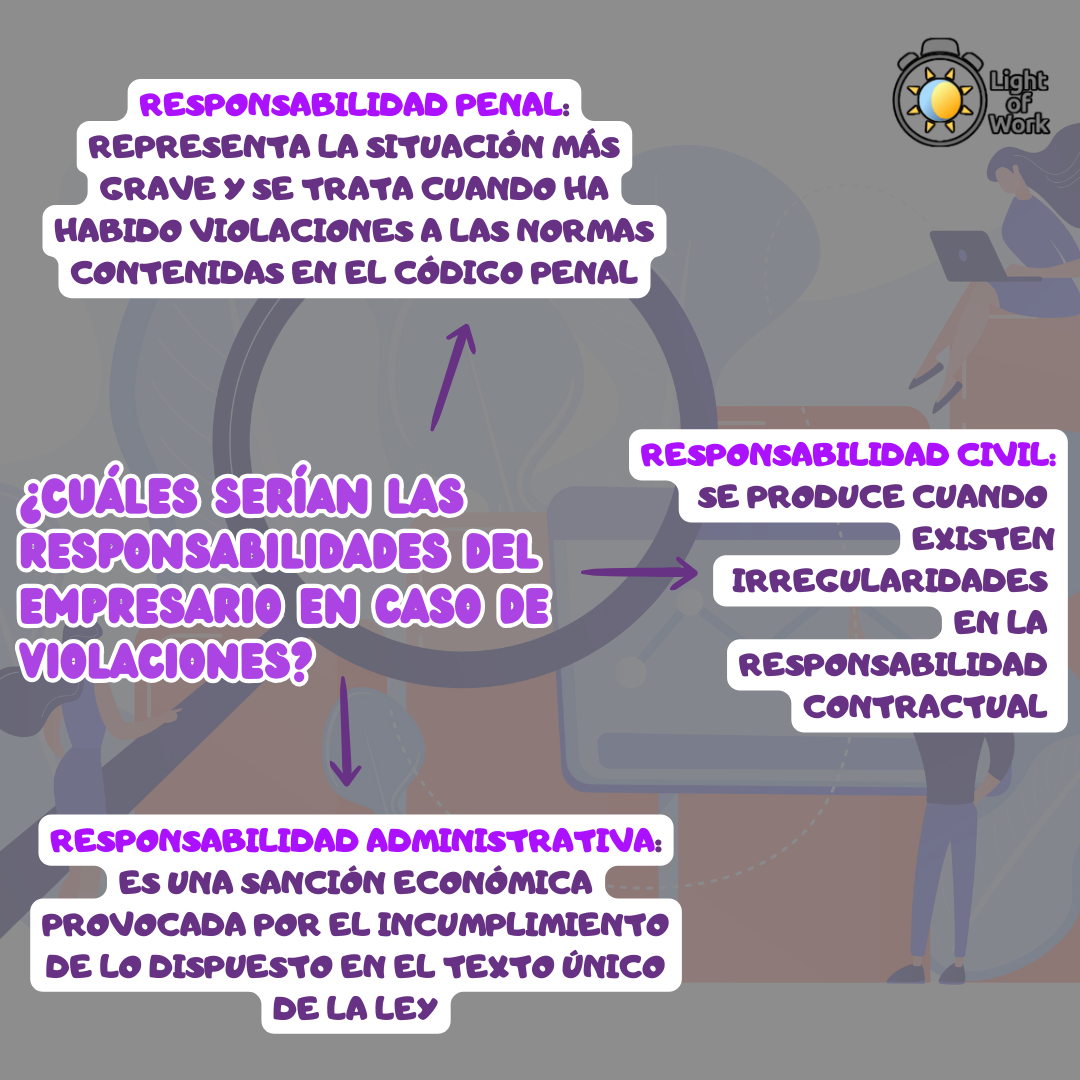
Image by vectorjuice on Freepik
You might be interested in: Operating and Professional Civil Liability
What penalties can the business owner risk?
It should be noted that, above all in economic terms, the offences that may occur are of three types: minor, serious and very serious. Of course, depending on their seriousness, different types of penalties and fines are imposed.
- Minor offences (there are also different levels): at the minimum level the fine is between 70 and 150 euros; at the medium level the amount is between 151 and 370 euros; and at the maximum level it can reach up to 750 euros.
- Serious: the categories are set at 751, 1500, 3751 and 7500 euros.
- Very serious: fines can start from 7501 euros and go up to 225,081 euros. To give a concrete example, the monetary penalties for an undeclared employee (that is, one not registered with a contract) is a very serious offence punishable by fines between 3126 euros and 10,000 euros.
All infringements are punished with fines and formal complaints before the magistrate. Generally, a period of 30 days is given to correct the irregularities found. If the corrections are made within this period, the complaint is closed; otherwise, the legal process continues with the corresponding consequences.
Our recommendations
The Labour and Social Security Inspectorate ensures compliance with labour and safety regulations, protecting workers' rights and promoting safe working conditions. However, it can be a real nightmare from the employers' perspective, so below we have highlighted a few useful tips to be prepared for possible ITSS visits.
First, it is essential that employers know and understand the labour laws relevant to their sector and type of business, as well as their responsibilities in areas such as contracts, working conditions and occupational safety. In other words, before an inspection, it is important to prepare by thoroughly reviewing labour practices and appointing a person responsible for cooperating with the inspectors during their visit.
Second, managers should keep detailed and up-to-date records of all aspects related to employment and establish clear and transparent internal policies on employment and occupational safety, making sure that all employees are informed and trained in this regard.
Finally, it is crucial to comply with all occupational health and safety regulations in the workplace, carrying out risk assessments and taking measures to mitigate any risk identified.